




A Cost-Effective Resistor with Excellent Insulation Properties
- 2024-12-24 09:50
Related links
본문

Chapter 5: Cement Resistors
A Cost-Effective Resistor with Excellent Insulation Properties
1. What is a Cement Resistor?
A cement resistor is a type of power resistor in which the resistive element is enclosed in a ceramic (cement) casing. This design enhances heat resistance and electrical insulation. In simple terms, the resistor is molded inside a ceramic housing to protect it from environmental factors such as temperature and humidity.
For instance, in a microwave oven, cement resistors help prevent internal circuits from overheating.
RMS Cement Resistors
|
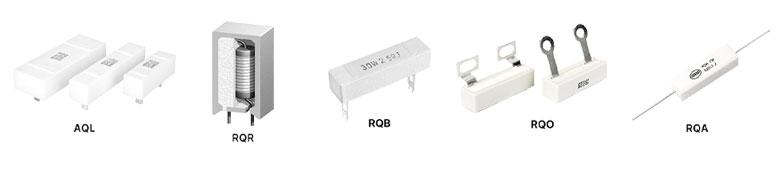
2. Types of Cement Resistors
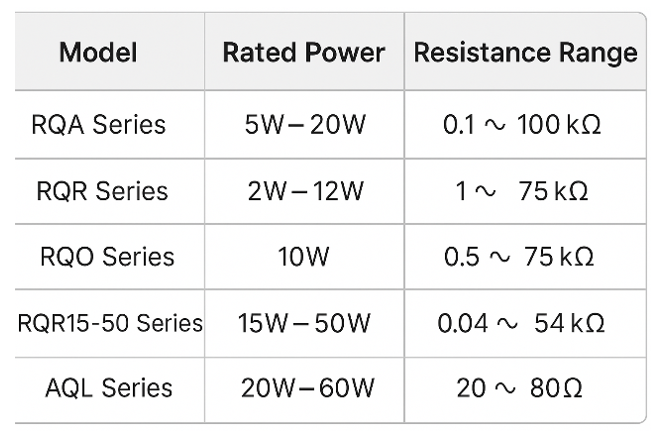
*AQL Series
• Certified to AEC-Q200, the automotive industry’s reliability standard
• Used as inrush current limiting resistors in EV, HEV, and PHEV Power Relay Assemblies (PRA)
3. Internal Structure of a Cement Resistor
1) Lead Wire • Connects the resistor to the external circuit via end caps • Conducts current in and out of the resistor • Typically made of tin-plated copper for superior conductivity 2) Cement Molding • Serves as a thermally conductive insulator • Encapsulates and protects internal components from moisture and mechanical shock 3) Ceramic Case • Encloses the entire assembly • Offers thermal insulation and mechanical strength • Withstands high temperatures 4) Ceramic Rod • Acts as the core for winding resistance wire or film deposition • Made from ceramic or fiberglass for heat resistance and electrical insulation 5) Resistive Element • The part that actually resists electrical current • Converts electrical energy into heat • Often a wire-wound or Metal Oxide Resistor (MOR) 6) End Cap • Conductive component that connects the resistive element to the lead wire • Provides structural integrity and electrical contact • Ensures mechanical and electrical stability at both ends |

Cement resistors are physically robust and can withstand harsh environments including moisture, dust, and chemicals.
• Cement molding absorbs mechanical shocks
• Ensures stable operation even in extreme conditions
2) Superior Insulation
These resistors provide excellent electrical insulation, making them ideal for high-voltage applications. • Prevent electric leakage and reduce risk of electric shock • Enhance safety in sensitive circuits |
Cement resistors are essential in safety-critical applications. Their thermal and mechanical stability ensures long-term reliability and circuit protection.
Industrial systems often operate under high voltage and current. Cement resistors are crucial in such settings to: • Limit current flow • Prevent overheating and overcurrent damage Wire-wound cement resistors offer: • Compact size • Excellent overload tolerance • High mechanical strength (MOR) • EMI suppression and stable frequency response |
1) Thermal Stability
Capable of operating in high-temperature environments by effectively dissipating heat and protecting sensitive components.
2) Long Life Span
6. How Cement Resistors Work
Cement resistors convert electrical energy into heat when current flows through the resistive element. • The ceramic casing efficiently disperses this heat • Prevents overheating and supports stable current control under high-power conditions |
In summary, cement resistors are indispensable components for industrial electronics. Their ability to perform reliably under high thermal and electrical stress makes them ideal for demanding applications. They protect both the equipment and the user—making them a critical part of modern electronic systems.