




The Magic of Resistors: The Secret Weapon for Controlling Electrical Flow
- 2024-12-23 14:57
Related links
본문

Chapter 1: Basic Knowledge of Resistors
The Magic of Resistors: The Secret Weapon for Controlling Electrical Flow
Resistors are one of the most commonly used components in electronic devices. As electronic devices have become more precise, energy-efficient, and compact, resistors have evolved to enhance their functionality. Innovations such as ultra-precision metal foil resistors and miniature chip products, like the 1005 size (1/12 watt, 1/16 watt), have emerged.
Required Properties of Resistor Materials
• Ability to provide a wide range of resistance values • Stability against temperature changes • Minimal aging effects • Physical and chemical stability • Good machinability • Adequate mechanical strength • Low thermal electromotive force with copper leads • Cost-effectiveness |
1. Ohm's Law: The Golden Rule of Resistors
Resistors control the flow of current in an electrical circuit, preventing excessive flow. Ohm's Law plays a key role in describing the relationship between current, voltage, and resistance in resistors.
Ohm's Law Formula: V=IxR • V: Voltage • I: Current • R: Resistance |
For example, when the voltage is constant, higher resistance reduces the current flow. This helps protect electronic devices from damage caused by overcurrent.
2. Types and Characteristics of Resistors
Resistors come in various shapes and size, and their operation depends on their resistance values, which are measured in ohms (Ω). The two most commonly used types of resistors are fixed resistors and variable resistors.
Source: Ariat Technology |
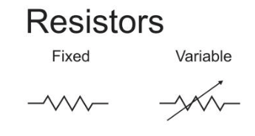
▶ Fixed Resistors
• Characteristics: Resistance value is fixed and does not change with external conditions. • Applications: Used to limit current or divide voltage. |
▶ Variable Resistors
• Characteristics: Resistance can be adjusted using a slider or dial. • Applications: Used for brightness control (lighting), volume control (speakers), motor speed control, etc. |
Resistors are broadly classified into fixed and variable types. Additionally, they can be further categorized by material, such as carbon-based and metal-based resistors.
3. Classification by Material
The material used in a resistor determines its performance and applications. The most common classifications are carbon-based and metal-based resistors.
▶ Carbon-Based Resistors
Made primarily from carbon, these resistors are cost-effective and widely used.
• Characteristics: - Economical and suitable for mass production - Sensitive to temperature changes, unsuitable for precision environments • Applications: Consumer electronics, simple circuits |
▶ Metal-Based Resistors
Made using metal film or metal oxide, these resistors offer higher precision and stability.
• Characteristics: - Highly resistant to temperature changes and stable over time - High accuracy, suitable for precision circuits • Applications: Medical devices, measuring instruments, precision electronics |
4. Resistance Value
The resistance value indicates how much a resistor limits the flow of current, measured in ohms (Ω).
• Higher resistance: Less current flows. - Example: Narrower hoses restrict water flow, just as higher resistance reduces current. • Lower resistance: More current flows. - Example: Wider hoses allow more water to flow, just as lower resistance increases current flow. |
Note: 1,000 Ω = 1 kΩ (kilohm), 1,000 kΩ = 1 MΩ (megohm).
5. Power Rating
The power rating is the maximum power (heat) a resistor can handle, measured in watts (W).
Resistors generate heat when current flows through them, and they must operate within their power rating.
• Low power rating: - The resistor may overheat and fail. • High power rating: - Offers stable performance but increases size and cost. |
Power Calculation: P=V×I Power (P) = Voltage (V) × Current (I) |
Ensure the power does not exceed the resistor's rating.
6. Power Rating
Resistance tolerance specifies the range within which the actual resistance value may vary from the stated value, expressed as a percentage (%).
• Importance of tolerance: - Precision circuits require resistors with low tolerance. - For instance, a resistor with a ±5% tolerance at 100 Ω may range from 95 Ω to 105 Ω. • Lower tolerance: Results in higher accuracy and reliability. - Precision devices often use resistors with ±1% or ±0.1% tolerance. |
If you understand the basic characteristics of resistors, it is time to explore how the way resistors are connected affects circuit behavior. Resistors are typically arranged in two ways: series connection and parallel connection. These configurations influence the total resistance and the flow of current in the circuit.
7. Series Connection
▶ Concept
In a series connection, components are connected in a single path. Current flows sequentially through each component. For example, connecting two bulbs in series allows the current to flow from the first to the second.
▶ Characteristics
• Uniform current: The same current flows through all components.
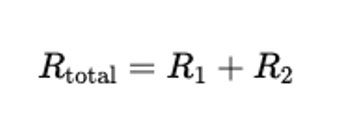
• Combined resistance: The total resistance is the sum of the individual resistances.
▶ Example
In a series connection, the resistance values combine, resulting in a higher total resistance. |
▶ Real-Life Example
• Connecting two bulbs in series: If one bulb fails, the other will not light, as current flow is interrupted. This is because the current flows through a single path.
8. Parallel Connection
▶ Concept
In a parallel connection, components are connected along multiple paths, each receiving power directly. For instance, two bulbs connected in parallel operate independently.
▶ Characteristics
• Split current: Current divides among the parallel paths.
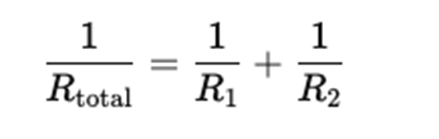
• Reduced resistance: The total resistance is calculated using the reciprocal sum of the individual resistances.
▶ Example
For two resistors R₁ and R₂ in parallel, the total resistance is :
In a parallel connection, the total resistance decreases. |
▶ Real-Life Example
• Connecting two bulbs in parallel: If one bulb fails, the other continues to operate because current flows independently to each bulb.
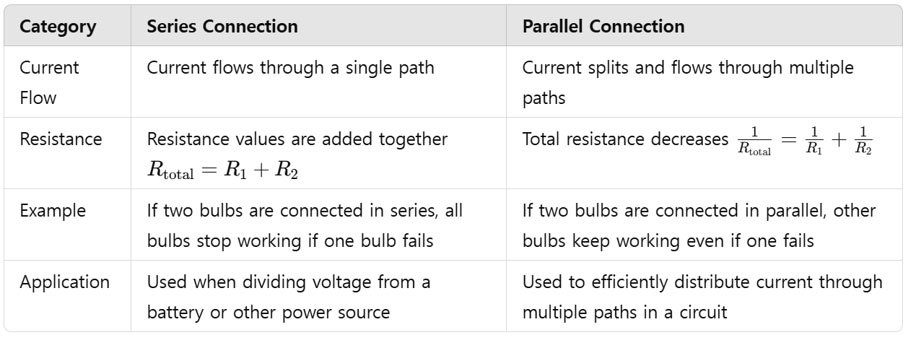
*Series connections maintain uniform current and increase total resistance.
*Parallel connections divide current and reduce total resistance.