




A Simplified Guide to the World of High-Voltage Resistors
- 2025-01-07 11:34
Related links
본문

Chapter 9: High-Voltage Resistors
A Simplified Guide to the World of High-Voltage Resistors
High-Voltage Resistors of RMS  |
2. Structure of a High-Voltage Resistor
1. Resistive Element - The core part that limits current flow. - Typically made from thick film or metal oxide materials to remain stable under high voltages. 2. Insulation - Encased in strong insulating material, often ceramic or glass, to withstand high voltages. - Provides safety and prevents external electrical contact. 3. Housing - Protective casing made of metal or plastic. - Shields against mechanical damage and aids in heat dissipation. 4. Terminals - Metal connectors at both ends for secure electrical contact. - Designed for reliable performance in high-voltage circuits. |
3. Why Are High-Voltage Resistors Needed?
1. Stability in High-Voltage Circuits - Prevents equipment damage, overheating, or fire by limiting excessive current. - Applications: Circuit protection, overcurrent prevention, electrical safety. 2. Precise Voltage Division and Measurement - Enables accurate voltage measurement and control by dividing voltage into specific ratios. - Applications: Voltage dividers, precision circuits, test instruments. 3. Energy Efficiency - Minimizes energy loss and enhances system efficiency in power-intensive environments. - Applications: High-efficiency circuits, energy-saving designs. 4. Wide Range of Applications - Power Transmission Systems: Controls current in high-voltage lines. - Medical Equipment: Ensures safe and accurate power control in devices like MRI scanners. - Testing & Measuring Equipment: Provides stability in high-voltage test systems. 5. Circuit Safety - Prevents sparks and short circuits by absorbing excessive current. - Critical for high-voltage circuit reliability. |
4. Key Features of High-Voltage Resistors
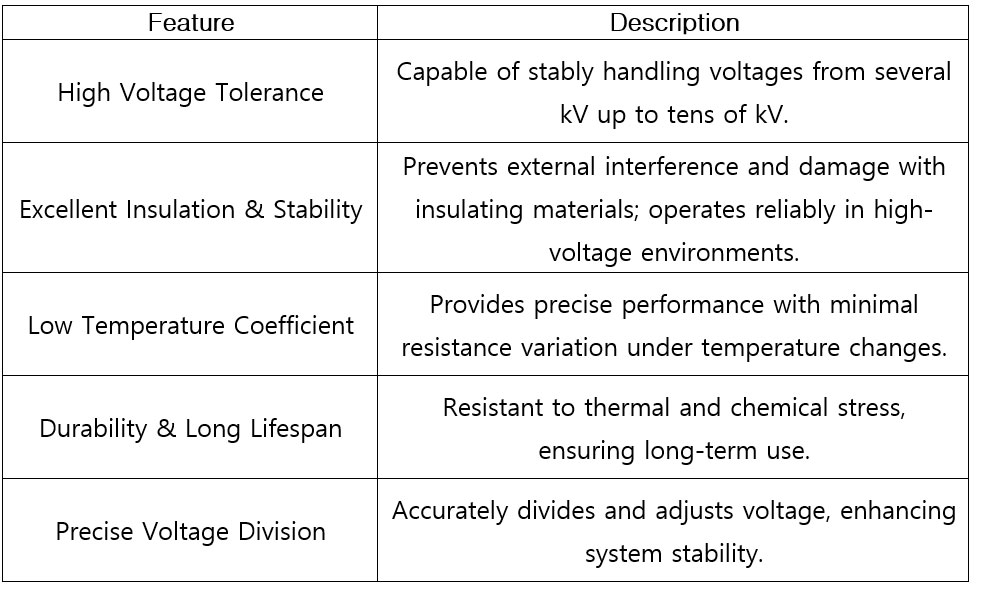
• High insulation resistance • Stable operation under extreme voltages • Long service life • Reliable thermal performance |
5. Types of High-Voltage Resistors
1. Ceramic High-Voltage Resistors - Structure: Ceramic body for insulation and thermal resistance. - Features: Excellent dielectric strength and heat tolerance. - Uses: Transmission systems, medical devices. 2. Metal Oxide Film Resistors - Structure: Coated with a metal oxide layer. - Features: Strong overload capability, stable under temperature changes. - Uses: Electrical test equipment, precision measuring devices. 3. Carbon Composition Resistors - Structure: Carbon powder mixed with binder. - Features: Excellent surge handling, fast response; generates more heat. - Uses: High-voltage pulse circuits, spark suppression. 4. Thin/Thick Film Resistors - Structure: Film deposited on a substrate. - Features: Compact size, precise resistance values, high-temperature stability. - Uses: Electronic devices, voltage sensors. 5. Wirewound Resistors - Structure: Metal wire (e.g., nichrome) wound on a core. - Features: High power handling, excellent heat dissipation, limited frequency response. - Uses: Power supplies, high-output voltage control. 6. Metal Glaze Resistors - Structure: Metal-glass mixture coated on a substrate. - Features: Resistant to moisture and chemical corrosion, long life. - Uses: Communication equipment, high-voltage circuit protection. |
6. Real-World Applications
• High-Voltage Power Supplies: Used in X-ray machines, laser systems, and other HV equipment for current control and stabilization. • Test & Measurement Instruments: Ensures safe and accurate performance in high-voltage testing environments. • Telecommunication Equipment: Provides signal processing and high-voltage protection in sensitive circuits. |
Medical Imaging Devices • Examples: X-ray, CT scanners, MRI systems. • Role of HVRs: - Control high-voltage pulses for high-resolution imaging. - Prevent transient overvoltage and instability for safe operation. |
7. Key Considerations When Choosing an HVR
1. Voltage Rating: Must withstand maximum operating voltage. 2. Resistance Value: Should match the specific circuit requirements. 3. Power Capacity: Ensure the resistor can handle expected loads. 4. Accuracy: Select precision level required for the application. 5. Temperature Coefficient: Evaluate resistance stability under temperature variation. |
8. Conclusion